
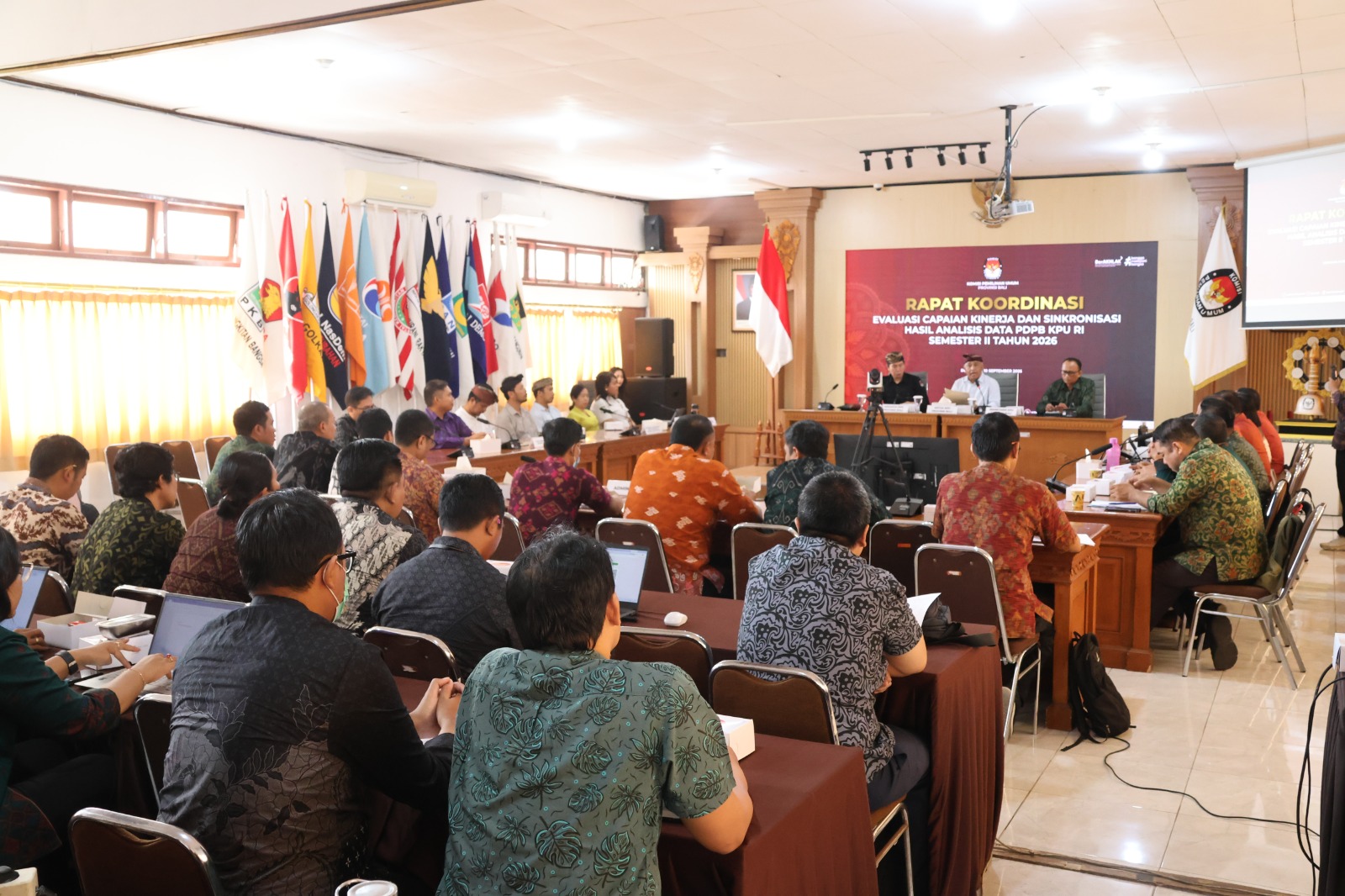
BALI — The Bali Provincial General Election Commission (KPU Bali) is strengthening coordination and synchronization of Continuous Voter Data (PDPB) to improve the accuracy and quality of voter data while supporting preparations for the 2029 General Election.
The effort was discussed during the Coordination Meeting on Performance Evaluation and Synchronization of the Analysis Results of the KPU RI Continuous Voter Data (PDPB) for Semester II of 2026, held online on Thursday (September 10, 2026).
The meeting was attended by officials from the Bali Provincial KPU, Regency/City KPU offices across Bali, as well as representatives from the Bali Provincial Social Affairs, Women's Empowerment and Child Protection Agency, the Community and Village Empowerment Agency, the Population and Civil Registration Office (Dukcapil), and the Bali Regional Office of the Directorate General of Corrections.
PDPB Also Supports Political Party Data Updates
Chairman of the Bali Provincial KPU, I Dewa Agung Gede Lidartawan, emphasized the importance of managing PDPB seriously and accurately.
According to Lidartawan, PDPB is not only used to continuously update voter data but will also become part of the ongoing process of updating political party data.
“PDPB data will also be used for the continuous updating of political party data,” said Lidartawan.
This approach is expected to strengthen the integration of electoral data and ensure that the information used by election organizers remains accurate and up to date.
Voter Data Compared with 2024 Election and Dukcapil Data
Bali KPU member I Gusti Ngurah Agus Dharmasanjaya encouraged the synchronization of PDPB with data from the 2024 General Election and Regional Elections, as well as population data provided by Dukcapil.
The synchronization will particularly focus on Ineligible Voter (TMS) data, residents aged 17 and above, and residents who are under 17 but have already married and therefore potentially meet the requirements to become voters.
According to Ngurah Dharmasanjaya, accurate voter data is also directly related to logistical and organizational planning for the 2029 Election.
This includes determining the required number of Polling Stations (TPS) and Polling Station Organizing Groups (KPPS).
Regency and City KPUs Conduct Field Verification
During the meeting, Regency and City KPU offices across Bali presented their respective analyses and follow-up actions concerning PDPB.
Several regions are still conducting field verification of TMS data, particularly information concerning voters who have died, moved to another domicile, or records indicating potential new voters.
The verification process is considered important to ensure that voter records accurately reflect the latest population conditions in each area.
Representative of the Bali Provincial Dukcapil Office, Anthony Sitorus, explained that differences between datasets may occur due to changes in population numbers from year to year.
Dukcapil regularly updates population records every month, including information on deaths and population movements. These updates are expected to help minimize discrepancies between voter data and population administration records.
Meanwhile, the Bali Regional Office of the Directorate General of Corrections is supporting the process by providing data on detainees and inmates. The data will be used to map voter requirements at special polling stations (TPS Lokasi Khusus).
The meeting also involved the Data and Information Center (Pusdatin) of the General Election Commission of Indonesia (KPU RI), which provided guidance regarding the results of data synchronization.
Pusdatin stated that records found to overlap would be rechecked against Dukcapil data. Additional datasets, including information on Indonesian voters living abroad and voters with disabilities, will also undergo further processing.
At the end of the meeting, Ngurah Dharmasanjaya expressed his appreciation for the work carried out by the Regency and City KPU offices throughout Bali.
He emphasized that Continuous Voter Data (PDPB) is a national priority program that must be managed properly, accurately, and consistently as part of preparations for the 2029 General Election.

