
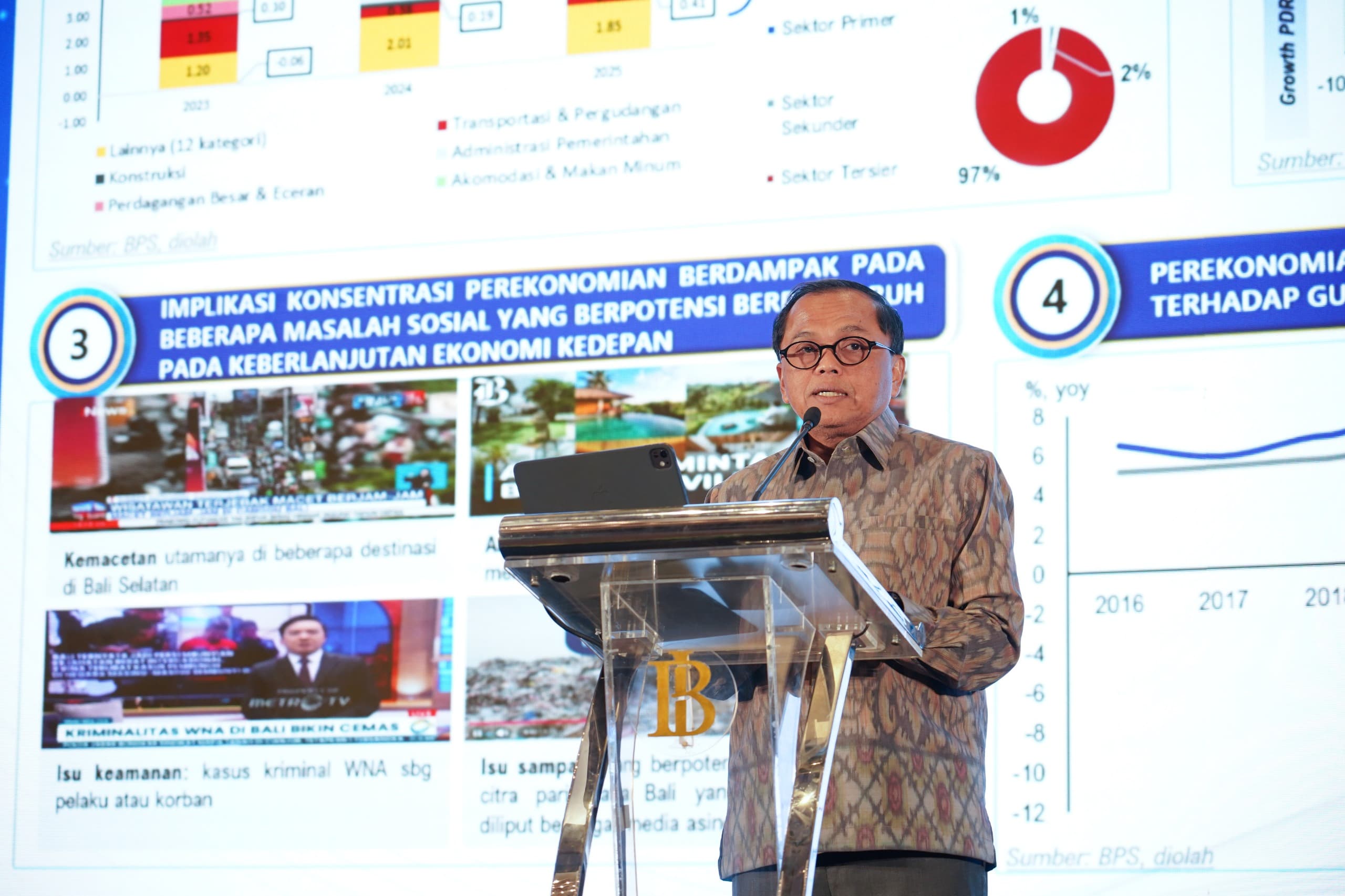
Held at Padma Resort Legian Bali on September 9, 2026, the forum carried the theme “Maintaining Stability and Promoting Bali’s Economic Growth to Accelerate the Kerthi Bali Economy.” The dialogue focused on formulating concrete strategies to build a resilient, inclusive, and sustainable Balinese economy.
The forum also featured the handover of Bank Indonesia’s Bali Provincial Economic Report (LPP) for the Second Quarter of 2026 to the Bali Provincial Government. In addition, BI distributed agricultural and fisheries equipment to local subak and fishing groups as part of its advisory role to regional governments and its support for Bali’s primary sectors.
Bali Economy Grows 5.78 Percent
Head of Bank Indonesia’s Bali Representative Office, Achris Sarwani, said Bali’s economy maintained positive momentum in the second quarter of 2026, recording 5.78 percent year-on-year (yoy) growth, above the national average.
Meanwhile, Bali’s inflation stood at 3.45 percent yoy in August 2026, remaining within the target range and helping maintain household purchasing power to support economic growth.
Looking ahead, Bank Indonesia expects Bali’s economy to continue growing strongly within the range of 5.4–5.9 percent.
However, Achris highlighted two fundamental challenges that require collective attention. The first is Bali’s continued sectoral dependence on the tertiary sector, particularly tourism, making the regional economy vulnerable to external shocks.
The second is the concentration of investment and economic activity in southern Bali, particularly the Sarbagia area.
Six Key Sectors Need Stronger Connectivity
Representing the Governor of Bali, Coordinator of the Bali Provincial Government’s Development Expert Group Prof. Dr. drh. I Made Damriyasa, M.S., reaffirmed the direction of Bali’s 100-Year Development Framework under Regional Regulation No. 4 of 2023 and its vision of Nangun Sat Kerthi Loka Bali.
He said Bali’s post-pandemic economic transformation requires stronger connectivity among six leading sectors: agriculture in a broad sense, marine and fisheries, manufacturing, industry and MSMEs/cooperatives, the creative and digital economy, and tourism.
“What needs to be built is not merely sectoral diversification, but connectivity between sectors,” Damriyasa emphasized.
The approach is expected to create stronger linkages across Bali’s economic sectors rather than allowing each sector to develop independently.
Eight Quick Wins to Strengthen Bali’s Economy
Chief Economist of Permata Bank Josua Pardede highlighted global developments, including geopolitical tensions in the Middle East that have affected oil and aviation fuel prices and weakened international air travel mobility.
He noted that Bali’s second-quarter growth was largely supported by government consumption and construction projects, while the transportation and warehousing sector experienced contraction.
To address bottlenecks in government spending and investment, Josua proposed eight quick wins.
They include front-loading capital expenditure through regional budgets and physical Special Allocation Funds, optimizing budget surpluses (SILPA), expanding El Niño mitigation measures in agriculture, strengthening market operations and Inter-Regional Cooperation (KAD), and developing alternative international flight routes.
Other recommendations include expanding People's Business Credit (KUR) distribution to primary sectors, with a minimum allocation of 30 percent, preparing a pipeline of 10 investment projects outside southern Bali, increasing compliance with the Foreign Tourist Levy, and strengthening the role of Village Credit Institutions (LPD) and traditional villages in distributing programs such as MBG, KDMP, and KUR.
Josua also stressed the importance of reducing economic leakage, or the loss of economic value generated in Bali but flowing out of the region.
PT SMI Offers Financing Support for Regional Development
Meanwhile, Aradhita Priyanti, Director of PT Sarana Multi Infrastruktur (PT SMI), explained the institution’s readiness to support regional development financing.
As a Special Mission Vehicle under the Ministry of Finance, PT SMI provides support through public lending schemes, Government and Business Entity Cooperation (KPBU), as well as project development and consulting services.
Aradhita emphasized that PT SMI applies strict Environmental, Social, and Governance (ESG) principles and feasibility assessments to ensure that financed projects are sustainable and aligned with environmental principles.
“Tourism for Bali, Not Bali for Tourism”
Tourism figure Prof. Dr. Ir. Tjokorda Oka Artha Ardana Sukawati (Cok Ace) called for a fundamental shift in Bali’s tourism development paradigm.
He introduced the principle: “Tourism for Bali, not Bali for tourism.”
Cok Ace emphasized the importance of managing Bali’s environmental carrying capacity, addressing waste through integrated solutions such as Waste-to-Energy (PSEL) projects, and strengthening local supply chains.
According to him, hotels and restaurants should increasingly absorb agricultural products and MSME products produced in Bali, allowing tourism to generate broader economic benefits for local communities.
He said transformation must move simultaneously across three key pillars: government, business, and communities and traditional villages.
The government needs coordinated policies and spatial planning rooted in Balinese culture. Businesses need to focus on value rather than simply pursuing volume, while communities and traditional villages must become active subjects in development.
Synergy Key to Bali’s Sustainable Economic Transformation
The Balinomics 2026 forum reaffirmed the commitment of Bank Indonesia, the Bali Provincial Government, and various stakeholders to strengthen cross-sectoral economic cooperation.
Harmonized policies and consistent implementation on the ground will be crucial to maintaining regional economic stability while accelerating Bali’s transformation toward a resilient, inclusive, and sustainable economy.
For Bali, the challenge is no longer simply how to achieve economic growth, but how to ensure that growth creates broader value, reduces dependence on a single sector, strengthens local economic linkages, and remains aligned with the island’s environmental and cultural foundations.


