
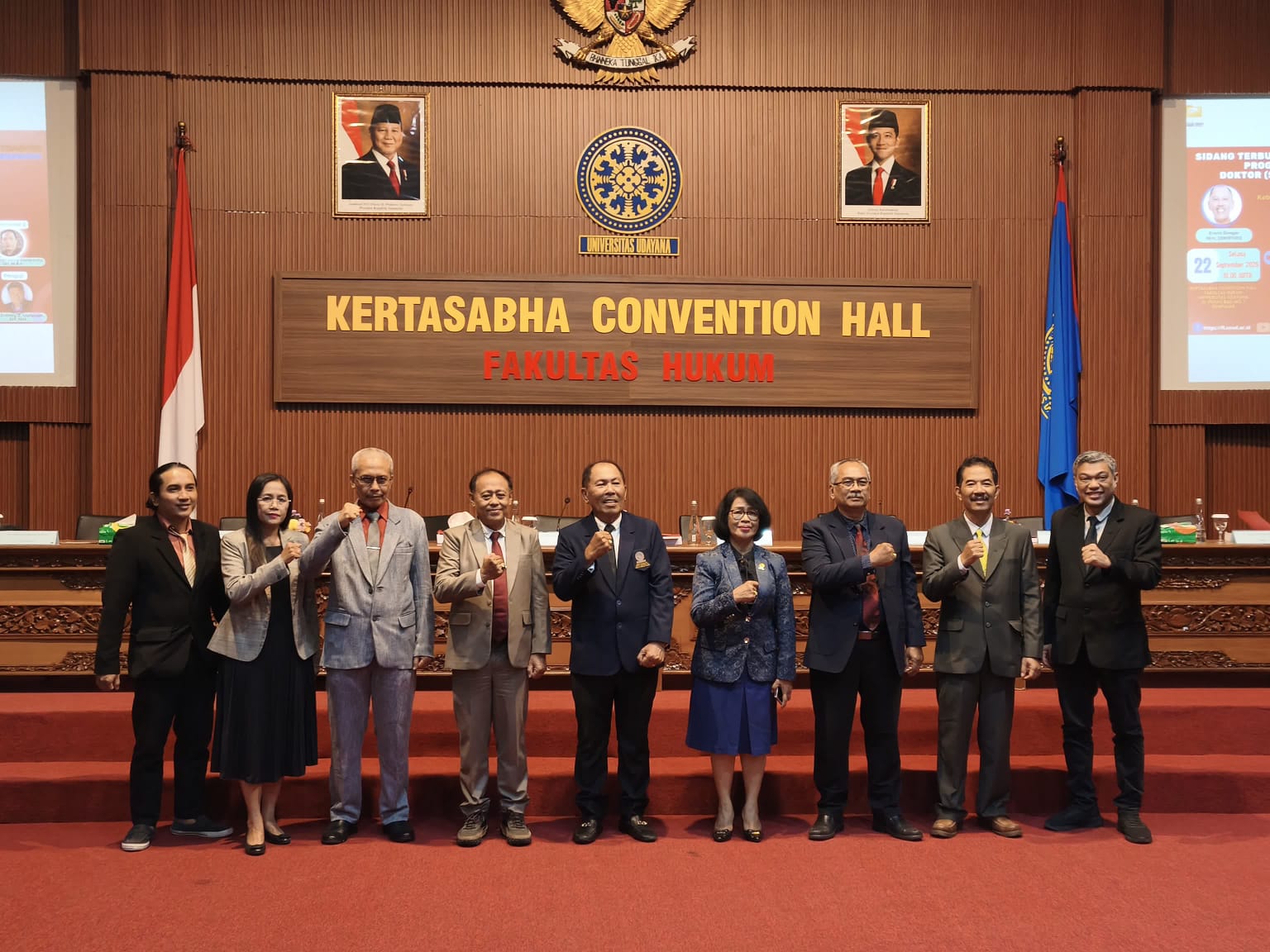
BALI — Prominent Medan-born lawyer Erwin Siregar has officially earned his Doctor of Law degree from the Faculty of Law at Udayana University after successfully defending his doctoral dissertation in an open doctoral promotion session on Tuesday (September 22, 2026).
The doctoral examination was held at the Kertasabha Convention Hall, Faculty of Law, Udayana University, beginning at 10 a.m. Bali time.
Erwin defended his dissertation titled “Freedom of Association for Lawyers in Indonesia,” a study examining the legal and organizational challenges surrounding lawyers' freedom to join and move between professional organizations in Indonesia.
The session was chaired by Prof. Dr. Putu Gede Arya Sumerta Yasa, S.H., M.Hum., who also served as an examiner. The examination panel included Prof. Dr. I Wayan Parsa, S.H., M.Hum., as promoter; Prof. Dr. Ni Luh Gede Astariyani, S.H., M.H., as co-promoter; and Dr. I Wayan Novy Purwanto, S.H., M.Kn.
Denpasar High Court Chief Judge Dr. Ifa Sudewi, S.H., M.Hum., served as the external examiner. Other examiners included Prof. Dr. Gde Made Swardhana, S.H., M.H., PP Dr. I Gede Pasek Eka Wisanjaya, S.H., M.H., and Dr. Jimmy Z. Usfunan, S.H., M.H.
In his dissertation, Erwin examines the principle of freedom of association among lawyers in Indonesia, including issues arising from lawyers moving from one professional organization to another.
He points to several cases involving lawyers who changed organizations as part of the background to his research. These include cases involving Firdaus Oibowo, Razman Nasution and other lawyers.
Erwin argues that freedom of association for lawyers is connected to the constitutional right to freedom of association and assembly. However, he also emphasizes that such rights are not absolute and may be regulated or proportionally restricted by law to protect the rights of others and serve the interests of a democratic society.
His research also examines the legal implications of Supreme Court Chief Justice Circular Letter No. 73/KMA/PH/01/9/2015, which he associates with the development of a multi-bar system in Indonesia.
According to his dissertation, recent Constitutional Court developments have further addressed the country's lawyer-organization system. However, Erwin identifies what he considers a regulatory gap concerning membership and movement between lawyer organizations.
From a sociological perspective, he argues that the absence of clear rules on organizational membership has contributed to disputes involving dismissals, transfers and the continuation of legal practice following organizational conflicts.
He says such issues could potentially affect perceptions of fairness and the image of the legal profession as an officium nobile.
Erwin's research focuses on three main questions: what constitutes freedom of association for lawyers, how lawyer organizations are regulated in Indonesia, and how lawyer organizations should be regulated from the perspective of ius constituendum—the law envisioned for the future.
The study seeks to analyze the nature of lawyers' freedom of association, the existing regulatory framework for lawyer organizations in Indonesia, and possible future legal arrangements.
The research uses a normative legal research method, applying statutory, conceptual, comparative and historical approaches. Its legal materials consist of primary, secondary and tertiary sources, with literature research used for data collection and descriptive, comparative, evaluative and argumentative methods used for analysis.
Erwin's theoretical framework includes the rule-of-law theory, legal certainty, legal protection, justice, legal construction, human rights, freedom of association and the concept of the legal profession.
He describes lawyers' freedom of association as freedom to uphold due process of law in pursuit of justice for both society and members of the legal profession. His dissertation also examines the continuing debate between a single-bar system and a multi-bar system for lawyers in Indonesia. Erwin maintains that freedom of association is constitutionally protected, while also emphasizing that the right is not unlimited.
As part of his comparative research, Erwin examines Vietnam, which he considers relevant because it also operates with multiple lawyer organizations while maintaining common professional oversight mechanisms.
Based on the comparison, he proposes the establishment of a National Supervisory and Ethics Council for Lawyers. The proposed body would oversee lawyers, conduct examinations, enforce professional ethics and impose sanctions across Indonesia. Erwin proposes that the council consist of 15 members: seven lawyers, two legal academics, two retired judges, two community figures, one retired prosecutor or law-enforcement official and one professional ethics expert.
Beyond the legal issues examined in his dissertation, Erwin's educational journey also drew attention during the doctoral examination.
He is described as the oldest doctoral student at the Faculty of Law at Udayana University. His journey began in Medan, where he sold ice cream while still in elementary school.
After graduating from high school, he financed his own university education. During his doctoral studies, he reportedly came close to giving up after two years, but continued with the support of his wife and children.
Prof. Dr. Putu Gede Arya Sumerta Yasa said age should not be a barrier to education, including for members of the legal profession.
He explained that doctoral programs are subject to academic and accreditation requirements, with three years considered the standard period for timely completion. Erwin, he said, completed the required stages in accordance with the established procedures.
Prof. Putu Gede Arya said Erwin entered the doctoral program at the age of 65 and completed it at 68. He described the achievement as evidence of strong determination and stamina, noting that doctoral study requires more than financial resources and also demands mental strength.
He also stressed the importance of knowledge for lawyers. According to him, lawyers play a balancing role in law enforcement and therefore need sufficient legal knowledge and professional capacity when defending clients and seeking the truth. A strong academic foundation, he said, is one element that can support lawyers in carrying out that role.
Denpasar High Court Chief Judge Dr. Ifa Sudewi, who served as an external examiner, also praised Erwin for completing his doctoral degree at the age of 68. Ifa said she had known Erwin for a long time and was surprised when he approached her and asked her to serve as an examiner.
She highlighted his determination to continue studying at an advanced age and noted that he completed the program relatively quickly. Ifa also praised aspects of Erwin's legal analysis, particularly his ability to examine specific legal provisions and develop them into detailed analysis within his dissertation.
At the end of the session, Erwin expressed his gratitude to several figures and leaders of lawyer organizations, including Deputy Coordinating Minister Otto, PERADI Chairman Hotman Paris, AAI Chairman Prof. Chandra, and Peradi Profesional Haris.


