BALI – Waste management in Bali is facing renewed scrutiny following inconsistencies found in waste management reports submitted by the Denpasar City Government and Badung Regency Government. The discrepancies have raised questions about the accuracy of reported waste reduction figures and the actual volume of waste transported to the Suwung Regional Landfill (TPA Suwung).
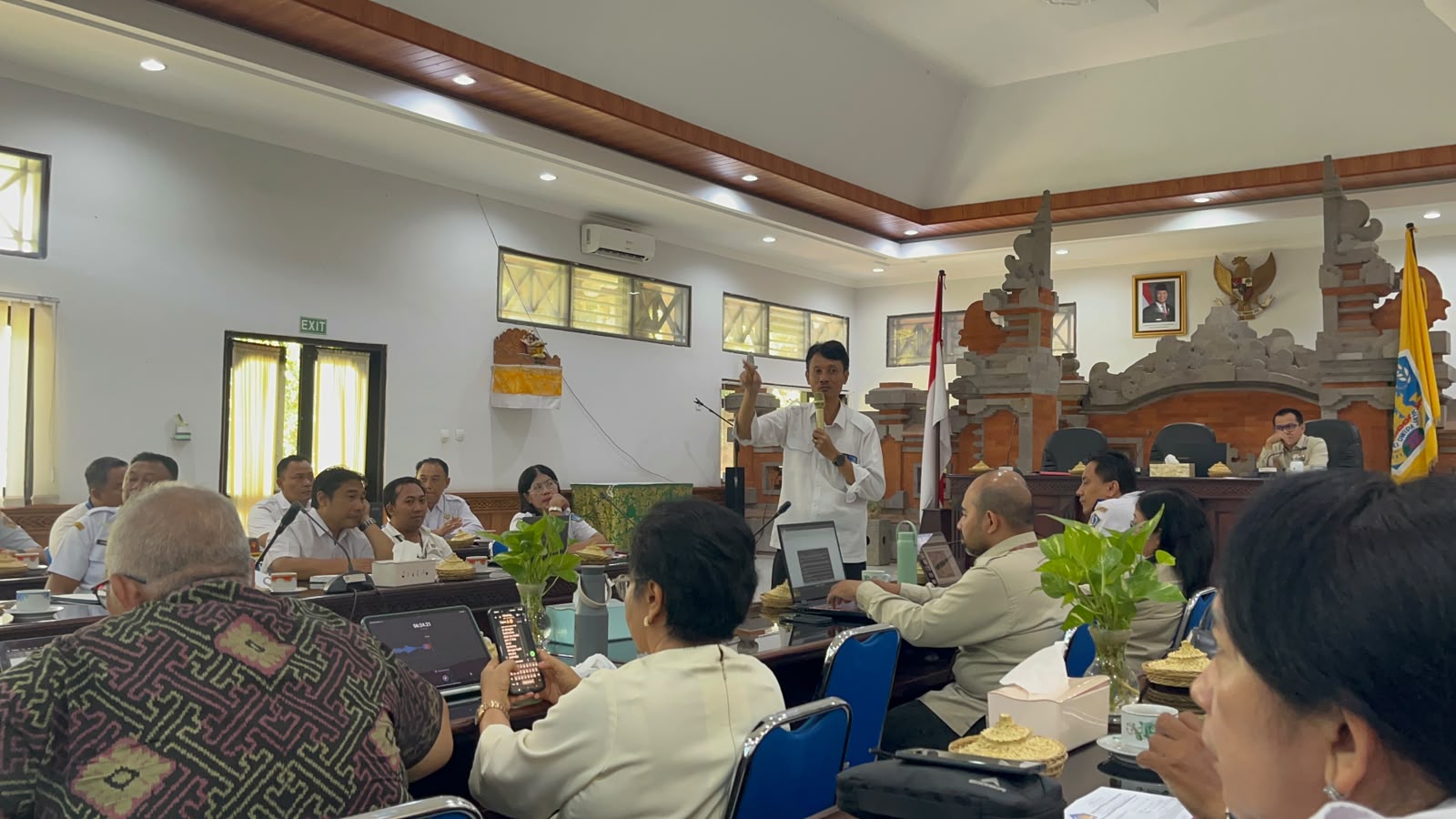
A review of the two government presentations, discussed during a coordination meeting at the Bali Provincial Environment and Forestry Agency office on Wednesday (November 18, 2026), found several differences in reported figures, including waste sorting achievements, composting facilities, processing capacities, and waste transportation data.
The meeting was chaired by Bali Environment and Forestry Agency Head I Made Dwi Arbani.
The main concern is whether the reported waste management achievements accurately reflect the amount of waste actually processed and the residual waste ultimately sent to the landfill.
Denpasar Reports 95.26% of Waste Is Managed
The Denpasar City Government reported that daily waste generation in 2026 reached approximately 1,033 tonnes.
Of the annual waste generation figure of 377,075.72 tonnes, approximately 359,217.66 tonnes were reported as managed, equivalent to 95.26%. The remaining 17,858.06 tonnes were categorized as unmanaged waste.
However, the reporting period and calculation methodology require clarification, as the 2026 reporting year had not yet ended on November 18.
It remains unclear whether the figures represent projections, annualized estimates, or actual recorded results.
Denpasar also reported operating 23 Reduce, Reuse, Recycle (TPS3R) facilities, processing approximately 78.531 tonnes of waste per day.
Meanwhile, the city's Integrated Waste Processing Facilities (TPST) were reported to have an optimal processing capacity of approximately 210 tonnes per day.
However, processing capacity does not necessarily represent actual daily output.
Residual waste also remains an important issue. The presentation estimated that around 30% of waste processed at TPS3R facilities and 10–20% at TPST facilities remained as residual waste.
This means that waste classified as managed may still eventually be transported to the Suwung landfill.
Discrepancies Found in Denpasar's Business Waste Sorting Data
Further inconsistencies were identified in data concerning waste sorting among hotels, restaurants, and cafes (HOREKA).
A monitoring chart covering 71 businesses showed that only five businesses, or 7.04%, had sorted their waste, while 66 businesses, or 92.96%, had not.
However, the accompanying narrative stated that most businesses had already implemented waste sorting.
Another discrepancy appeared in the organic waste management data.
The presentation listed 97 monitored businesses, but the reported categories included 42 businesses processing organic waste, 31 using third parties or disposing of waste at temporary collection points, and 34 businesses that neither sorted nor processed their waste.
These categories total 107 entries, exceeding the reported number of monitored businesses by 10.
Clarification is needed to determine whether businesses were included in multiple categories or whether an aggregation error occurred.
Badung's Waste Management Figures Also Require Clarification
The Badung Regency Environment and Sanitation Agency (DLHK) reported that waste generation in 2025 reached 876.1 tonnes per day.
Of this amount, 475.3 tonnes per day were categorized as managed waste, equivalent to approximately 54.25%.
The arithmetic difference between total waste generation and managed waste stands at 400.8 tonnes per day.
However, this figure cannot automatically be interpreted as waste sent to the landfill or unmanaged waste, as the definitions and reporting scope of the indicators still require clarification.
Badung's presentation also included an optimal waste management scenario targeting only 55 tonnes per day being sent to the landfill.
This figure represents a planned scenario rather than verified actual landfill weighbridge data.
Questions were also raised about the operational capacity of several processing facilities.
At the Mengwitani Integrated Waste Processing Facility, three RDF machines were reported to have a combined capacity of 300 tonnes per day and began operating on October 1, 2026.
The presentation also listed eight incinerator units with a capacity of 40 tonnes per day.
Meanwhile, the Padang Seni facility contained conflicting capacity information. The written description stated 40 tonnes per day, while the accompanying image caption listed 20 tonnes per day.
The difference requires clarification, particularly regarding installed capacity versus effective operational output.
Fewer Trucks Do Not Necessarily Mean Less Waste
Badung's presentation also showed changes in the number of waste collection vehicles transporting waste to the Suwung landfill.
The average number of vehicles reportedly declined from 166 per day in May 2026 to 149 in June, 127 in July, and 109 in August.
However, the figure increased again to 127 vehicles per day in September.
This indicates that the decline was not consistent.
More importantly, vehicle numbers alone cannot establish the actual volume of waste transported.
Accurate verification requires gross vehicle weight, empty vehicle weight (tare), and net waste weight for every delivery.
How Much Waste Actually Reaches Suwung Landfill?
The most significant gap in the two presentations is the absence of detailed daily net weight records showing how much waste from Denpasar and Badung actually enters the Suwung landfill.
As external context, reports on landfill operations recorded an average of 1,320 tonnes of net waste per day, with 591 vehicles per day, during September 21–27, 2026.
On November 12, 2026, Bali Environment and Forestry Agency Head I Made Dwi Arbani reportedly stated that the landfill received approximately 1,100 tonnes of waste per day.
The two figures differ by 220 tonnes per day.
However, this difference cannot automatically be interpreted as an actual decline in landfill waste because the reporting periods, vehicle coverage, and calculation methods may differ.
Neither figure provides a detailed breakdown of waste originating from Denpasar, Badung, and other regions.
Therefore, access to the landfill's weighbridge records is essential to verify whether local government reports correspond with actual waste deliveries.
Greater Transparency Needed in Bali's Waste Management
To establish accurate figures, data reconciliation is needed between the Bali Provincial Environment and Forestry Agency, Denpasar City Government, Badung Regency Government, and the Suwung landfill management authority.
The required records should include weighing dates and times, vehicle identification, waste origins, gross weight, tare weight, and net weight.
Operational data from TPS3R and TPST facilities should also be examined, including incoming waste, processed products such as compost and refuse-derived fuel (RDF), residual waste, and changes in stock levels.
The discrepancies identified in the two government presentations warrant official clarification.
However, the findings do not yet establish evidence of data manipulation or prove that the actual volume of waste delivered to Suwung differs from the figures reported by local governments.
Ultimately, transparent access to primary data and independent reconciliation of weighbridge records are necessary to determine how effectively Bali is managing its waste.
Residents deserve clear information about how much waste is reduced, how much is genuinely processed, and how much still ends up at the Suwung landfill.